Home › Equipment › Mini diggers
Mini digger hire in Spain
On the Spanish coast the mini digger is the machine that gets a pool dug, a terrace levelled or a drainage run cut through a slope — provided it can physically get through the gate. Tecnourban takes your brief in English and returns up to 3 quotes for the right weight class, with or without an operator, from suppliers who deliver to your postcode.
Typical models
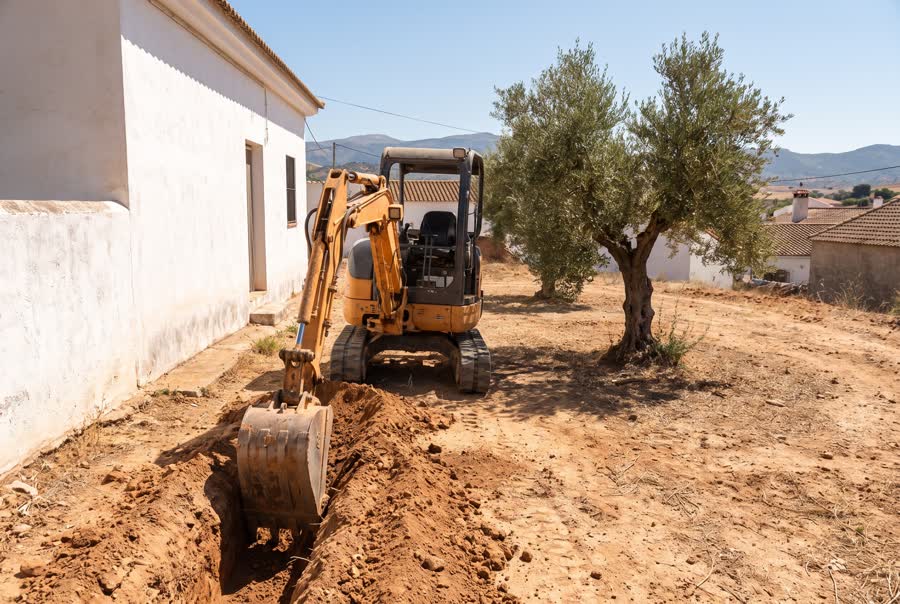
Mini digger 1.5–2 t
- Operating weight: 1.5–2 t
- Access width: from roughly 1 m
- Dig depth: around 2.3–2.6 m
- Typical use: Gardens, drainage, footings
€100/day
Check availabilityMini digger 2.5–3.5 t
- Operating weight: 2.5–3.5 t
- Access width: around 1.5 m and up
- Dig depth: around 3–3.5 m
- Typical use: Pools, terracing, bulk digging
€150/day
Check availabilityDumper 1–3 t
- Payload: 1–3 t
- Drive: Four-wheel drive, site tyres
- Tipping: Front skip
- Typical use: Spoil and stone on slopes
€70/day
Check availabilityPrices 2026
How much does it cost to hire a mini digger in Spain?
Hiring a mini digger in Spain costs from €100 per day excluding VAT for a 1.5–2 tonne machine, and €150–280 per day for the 2.5–3.5 tonne class; delivery is charged separately at €100–250 each way and 21% IVA is added at invoice.
| Machine | Day | Week | Month | Deposit |
|---|---|---|---|---|
| Mini digger 1.5–2 t | €100–180 | €400–700 | €1,000–1,700 | €400–1,000 |
| Mini digger 2.5–3.5 t | €150–280 | €600–1,100 | €1,500–2,600 | €600–1,500 |
| Excavator 7–20 t | €161–450 | €645–1,800 | €1,600–4,200 | €1,500–4,000 |
| Skid steer loader (Bobcat type) | €120–190 | €480–740 | €1,200–1,800 | €600–1,500 |
| Dumper 1–3 t | €70–140 | €280–540 | €700–1,300 | €400–1,000 |
Indicative market prices excluding VAT (21% IVA). A week costs roughly four daily rates and a month roughly ten to twelve. Delivery is charged separately at €100–250 per journey, and there are two journeys.
Access first: the gate decides the machine
On a Spanish villa plot the limiting factor is almost never the digging. It is the route from the road to the hole. Before anyone quotes on a machine, measure the narrowest point of the approach — normally a side gate, a pergola, a passage between the house and a boundary wall, or the turn at the top of a drive — and give that number to the hire desk.
What passes through what
- A 1.5–2 t machine with the tracks retracted will generally pass an opening of around a metre. This is the class that gets into rear gardens on urbanisation plots and it is why it is the most-hired digger on the coast.
- A 2.5–3.5 t machine needs roughly a metre and a half or more. It digs faster and deeper, but if it cannot reach the work it is worthless regardless of the rate.
- An excavator of 7 t or more is a road-access machine. On residential plots it is generally used from outside a boundary or on open land, not threaded through a property.
Slopes, steps and surfaces
Spanish coastal plots climb. A tracked machine handles a considerable gradient, but it will not climb steps, and it will not reverse blindly down a slope with spoil in the bucket. Two things follow. First, if the working area is on a terrace above or below the access point, ask whether the machine can physically get there or whether the job needs a smaller machine plus a dumper to shuttle material. Second, if the route crosses finished surfaces — tiled terrace, pool surround, resin driveway — say so at quote stage. Track marks and cracked tiles are a common and entirely avoidable dispute; boards or mats can be arranged when the supplier knows in advance.
Photograph the approach
The single most useful thing you can send with an enquiry is three photographs: the gate or entrance, the route to the work area, and where a lorry could stop to unload. It takes thirty seconds and removes almost all of the guesswork that leads to the wrong machine arriving.
What people actually use mini diggers for on the coast
The Spanish coastal renovation market has a fairly predictable set of digging jobs, and knowing which one you have makes the specification straightforward.
Pool excavation
The classic reason a foreign owner hires a digger. A domestic pool is a serious volume of spoil — most plots have nowhere to put it, so the excavation is really two problems: digging, and getting the material off site. Budget for a 2.5–3.5 t machine at €150–280 per day where access allows, a dumper at €70–140 per day to move spoil to a loading point, and skip or muck-away costs on top. If the plot only takes a 1.5–2 t machine, the dig is still possible but expect it to take meaningfully longer.
Terracing and retaining walls
Sloping plots get carved into levels, and that means cutting into the hillside, digging footings for a retaining wall and backfilling behind it. This is where machine choice and rock matter: much of the Spanish coast is limestone and it varies from diggable to genuinely hard within the same plot. If you hit rock, a mini digger with a breaker attachment or a separate hydraulic breaker at €25–55 per day is the usual answer — confirm at the quote stage whether a breaker can be supplied with the machine rather than sourcing one separately mid-job.
Drainage on slopes
One of the most common calls after the first serious autumn rain. Water coming off a hillside finds the lowest point of a property, and that is often a garage or a lower terrace. The work is trenching for drainage runs, soakaways and channel drains — perfect 1.5–2 t territory, since the trenches are narrow and the access is usually tight.
Groundwork and clearance
Removing old paving, taking out root-bound planting and palm stumps, levelling for a new terrace or a garden room, digging footings for a boundary wall. Short jobs, generally one to three days, and the class where a weekly rate rarely applies but a well-planned single day does a great deal.
With or without an operator
Unlike access platforms, there is no equivalent of the PEMP training obligation that governs whether you may drive a mini digger on your own property. But hiring with an operator is still extremely common in Spain, and for foreign owners it is often the better value once you count the real costs.
What self-drive assumes
Self-drive hire assumes you can operate the machine competently and safely, that you know how to check for buried services before you dig, and that you accept responsibility for damage. On a construction site in Spain, as opposed to your own garden, RD 1215/1997 applies to mobile work equipment and the employer must be able to show that whoever operates it has specific training for that machine. If your works are being run by a contractor with a safety plan, the operator question is theirs to document, not something to improvise.
What an operator brings
An experienced operator digs several times faster than an occasional user, arrives with their own accreditation and insurance, and — most valuable of all on a Spanish plot — knows what the ground does locally. The commercial trade-off is simple: an operated day costs more than a bare machine day, but if the operator finishes in one day what would take you three, you have paid less overall and hired less transport.
Buried services
This deserves its own warning. Older Spanish properties routinely have irrigation lines, pool plumbing, unmarked electrical supply and septic drainage running where no plan records them. Before any digging, establish where services run and dig by hand around anything uncertain. Striking a supply is expensive and, in the case of a live cable, dangerous — and it is not covered by the machine's insurance.
Delivery, deposits and what the daily rate excludes
The rate you compare is the machine alone. Everything below is normal in Spain and belongs in the budget from the start rather than appearing on the invoice.
Delivery
Charged separately at €100–250 per journey, twice — out and back. On a one-day hire of a small digger the transport can approach the cost of the machine, which is the classic surprise for anyone used to collecting a machine themselves. It is also the strongest argument for planning: if you can bundle the digging into a single continuous booking rather than two separate days a fortnight apart, you save an entire round of transport.
Deposit
The fianza runs €400–1,000 on a 1.5–2 t machine and €600–1,500 on the 2.5–3.5 t class, held on a card or by transfer and released after the machine is inspected back at the depot. Photograph the machine at delivery and at collection, including the tracks and the bucket edge.
Attachments, fuel and cleaning
Buckets of different widths are usually included; breakers, augers and grabs normally are not and are priced as extras, so ask when you request the quote rather than mid-dig. Diesel machines arrive with a full tank and must be returned full or you are billed for refuelling. Returning a machine caked in clay or concrete attracts a cleaning charge, and some contracts cap daily engine hours, typically at eight.
VAT
Every price here is excluding VAT, as is standard for Spanish equipment hire. 21% IVA is added at invoice. British customers should assume the quoted figure is not what leaves the bank account — this is the most frequent misunderstanding on a first hire in Spain.
Where we can deliver a mini digger
Suppliers work in a radius from their depot, so the yard nearest you drives the transport charge more than the province does. Three areas cover most of the demand from foreign owners.
Costa del Sol
Depots around Málaga and the Guadalhorce valley serve Marbella, San Pedro, Estepona, Benahavís, Mijas, Fuengirola and Benalmádena. The 1.5–2 t class is the workhorse here because urbanisation plots are steep and gated. Availability is generally good but tightens through the winter renovation season.
Costa Blanca
Yards near Alicante, Elche, Torrevieja, Benidorm and Dénia cover the coast from Pilar de la Horadada to Jávea. Pool and drainage work dominates, and the middle of the coast is competitive enough that it pays to compare quotes from depots in both directions.
Mallorca
The island has a fixed fleet and no neighbouring depot to borrow from, so allow two to four weeks' notice in season. Standard mini diggers are held in reasonable numbers; it is the specialist kit that runs out. Rural finca work, terracing and stone walling are the typical jobs, often at the end of tracks that decide the machine size for you.
Tell us the postcode, the dates and the width of the narrowest gate and we will find the depot that can deliver without the transport charge dominating the quote.
FAQ
Mini diggers — Common questions
How much does it cost to hire a mini digger in Spain?
A 1.5–2 tonne machine costs €100–180 per day excluding VAT and €400–700 for a week. The 2.5–3.5 tonne class is €150–280 per day and €600–1,100 per week. Delivery is charged separately at €100–250 each way and 21% IVA is added at invoice. From about four days onwards the weekly rate is much better value, since a week costs roughly four daily rates.
Will a mini digger fit through my villa gate?
A 1.5–2 tonne machine with retracted tracks will generally pass an opening of around a metre, which is why it is the standard choice for rear gardens on the coast. A 2.5–3.5 tonne machine needs roughly a metre and a half or more. Measure the narrowest point of the whole route, not just the gate, and send a photograph with your enquiry.
Do I need a licence to operate a mini digger in Spain?
There is no driving licence requirement for working on private ground. On a construction site, however, RD 1215/1997 requires the employer to entrust mobile work equipment only to people with specific documented training for that machine, so if your works are run by a contractor under a safety plan the operator's training must be documented. For a one-off job with no experienced driver, hiring with an operator is the simplest route.
What size digger do I need for a swimming pool?
Where access allows it, a 2.5–3.5 tonne machine at €150–280 per day is the sensible choice — it digs deeper and faster and copes better with hard ground. If the plot only takes a 1.5–2 tonne machine the dig is still possible but slower. Budget separately for moving the spoil: a dumper at €70–140 per day plus muck-away, since most plots have nowhere to store the material.
Can I hire a mini digger with an operator?
Yes, and it is common in Spain. An experienced operator works several times faster than an occasional user, brings their own accreditation and insurance, and knows the local ground conditions. On short jobs the higher day rate is frequently offset by finishing sooner and paying for fewer days of machine and transport.
Is a breaker included if I hit rock?
No. Standard buckets are usually included, but breakers, augers and grabs are priced as extras. Much of the Spanish coast is limestone that varies from easy to genuinely hard within one plot, so ask at the quote stage whether a hydraulic breaker can come with the machine. A separate electric or pneumatic breaker runs €25–55 per day.
Is delivery included in the daily rate?
No, transport is a separate line at €100–250 per journey depending on distance and machine size, and there are two journeys. On a single-day hire it can approach the cost of the machine itself, so ask for it to be itemised on every quote and consider bundling your digging into one continuous booking.
How much deposit will I be asked for?
Typically €400–1,000 for a 1.5–2 tonne machine and €600–1,500 for the 2.5–3.5 tonne class. It is held on a card or paid by transfer and released after the machine has been inspected back at the depot rather than at the moment it leaves your property, so allow a few days for it to return.
Do these prices include VAT?
No. All figures are excluding VAT, which is the standard convention for equipment hire in Spain, and 21% IVA is added at invoice. If you are registered as a business or self-employed in Spain, that VAT is recoverable, and you will receive a full tax invoice with the supplier's fiscal details.
What should I check before digging on an older Spanish property?
Buried services. Older properties routinely have irrigation lines, pool plumbing, unmarked electrical supply and septic drainage running where nothing is recorded on a plan. Establish where services run before starting, dig by hand around anything uncertain, and treat unmarked cable as live. Damage from striking a service is not covered by the machine's insurance.
Local coverage
Mini digger hire in Spain — Other locations
Ready? Request a quote in one minute.
Up to 3 quotes from local suppliers. Free, no obligation.