Generator hire in Spain
Whether it is a finca with no mains supply, a renovation where the power has been isolated, or a marquee in a field, the question is always the same: how many kVA, and single or three-phase? Tell us what has to run and we come back with up to 3 quotes for a correctly sized set from suppliers who deliver to your location.
Typical models
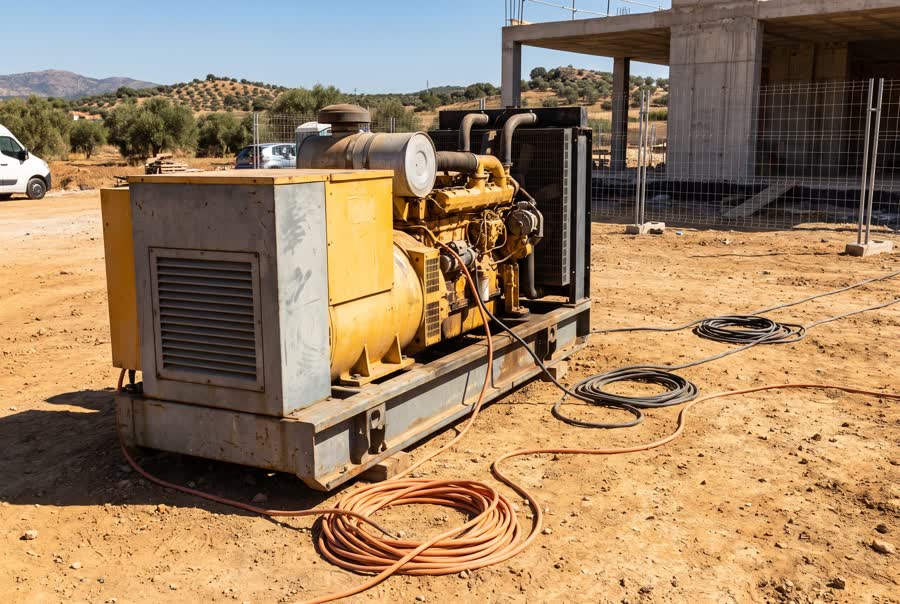
Generator 3–5 kVA
- Output: 3–5 kVA
- Supply: Single-phase 230 V
- Typical load: Hand tools, lighting
- Portability: Wheeled or carried
€28/day
Check availabilityGenerator 10–20 kVA
- Output: 10–20 kVA
- Supply: Single or three-phase
- Typical load: Mixer, breaker, compressor
- Portability: Skid or towable
€55/day
Check availabilityGenerator 60–100 kVA
- Output: 60–100 kVA
- Supply: Three-phase 400 V
- Typical load: Whole site or event
- Portability: Delivered on a lorry
€150/day
Check availabilityPrices 2026
How much does it cost to hire a generator in Spain?
Hiring a generator in Spain costs from €28 per day excluding VAT for a 3–5 kVA single-phase set, €55–120 per day for 10–20 kVA and €150–300 per day for 60–100 kVA; fuel and delivery are charged separately and 21% IVA is added at invoice.
| Output | Day | Week | Month | Deposit |
|---|---|---|---|---|
| Generator 3–5 kVA | €28–55 | €110–210 | €300–550 | €150–400 |
| Generator 10–20 kVA | €55–120 | €220–450 | €600–1,100 | €300–800 |
| Generator 60–100 kVA | €150–300 | €600–1,150 | €1,500–2,800 | €800–2,000 |
Indicative market prices excluding VAT (21% IVA). A week costs roughly four daily rates and a month roughly ten to twelve. Fuel is not included, and delivery is charged separately at €100–250 per journey for the larger sets.
Sizing: how many kVA do you actually need?
Getting the size right is the whole job. An undersized generator trips out repeatedly and wastes a day of everybody's labour; an oversized one costs more, burns more fuel and, if it runs lightly loaded for weeks, is not good for the engine either. Two numbers matter.
Running load and starting load
Add up what will run at the same time — not everything you own. Then account for the fact that anything with an electric motor draws a substantial surge on start-up, several times its running figure for a moment. A concrete mixer, a compressor, a submersible pump or a large angle grinder can therefore demand far more at the instant of starting than its rating suggests. This is the single most common reason a generator that looks big enough on paper keeps cutting out on site. Tell the supplier every motorised item you plan to run and they will size for the surge.
Three practical brackets
- 3–5 kVA (€28–55 per day). Hand tools, site lighting, a small pump, charging batteries. The set one person can move. Enough for a tiling or plastering job or for keeping a fridge and lights going through a power cut.
- 10–20 kVA (€55–120 per day). The realistic size for a working renovation, where a mixer, a breaker and a compressor may all run together. Also the usual choice for a small event with catering.
- 60–100 kVA (€150–300 per day). Whole-site or whole-event power: multiple trades, a marquee with lighting, catering and sound, or temporary supply for a building. Delivered on a lorry and typically three-phase.
Ask for the load calculation in writing
A good supplier will happily confirm on the quote that the set they are offering covers the list of equipment you gave them. That single line protects you: if the machine then trips constantly because it was undersized against a list you supplied accurately, the conversation is a very different one.
Single-phase or three-phase: the Spanish specifics
This is where British and northern European customers most often get caught, because domestic supply arrangements in Spain differ from what they are used to at home.
Voltage and phases
Spain runs on 230 V single-phase for domestic supply and 400 V three-phase for larger installations, at 50 Hz — the same frequency as the UK, so British tools work normally on the voltage side. What differs is how often three-phase turns up in an ordinary property. Rural and older Spanish houses, and plenty of village properties, have a three-phase supply, and if you have a borehole pump, a large air conditioning installation or workshop machinery, there is a good chance it is three-phase. If you replace a mains supply with a generator during works, the generator has to match what the equipment expects: a three-phase pump will not run from a single-phase set.
Contracted power is a Spanish quirk worth knowing
Spanish domestic electricity contracts specify a potencia contratada — a contracted power limit, in kW, above which the meter simply trips. It is common for older or holiday properties to be on a low contracted power that was fine for a fridge and some lights and is nowhere near enough for renovation tools. That is why generators get hired on properties that do have mains power: not because the supply failed, but because the contracted limit cannot carry the work. If your breaker keeps tripping the moment a second tool starts, that is very likely what you are seeing, and a hired generator is often quicker than changing the contract.
Connections and plugs
Spanish sets use standard industrial connectors — the blue single-phase and red three-phase IEC 60309 types — alongside domestic sockets on smaller units. Tell the supplier what your equipment terminates in, and if anything is to be connected to a property's installation rather than plugged directly into the set, that connection must be made by a competent electrician with proper isolation from the mains. Never improvise a connection into a house circuit.
Off-grid fincas, power cuts and events
Three quite different situations account for most generator hire among foreign owners in Spain, and each one has its own pitfalls.
Off-grid and rural properties
Plenty of inland fincas have no mains connection at all, or a supply so limited it cannot support building work. Here the generator is the site's entire electrical infrastructure for the duration, which changes the priorities: reliability, a tank that lasts a working day, and somewhere secure to keep it. Fuel is normally your responsibility — sets are supplied full and expected back full — and on a remote plot the logistics of refuelling deserve a moment's planning. If the property has solar with battery storage, say so: sometimes a smaller set used to cover peak demand is a better answer than powering everything from fuel.
Power cuts
Coastal and rural areas do experience outages, particularly after autumn storms, and long cuts are a real risk for anyone with a pool pump, a freezer full of stock or a business to run. A 3–5 kVA set at €28–55 per day covers essentials. Two cautions. First, in a genuine regional emergency every hire company is fielding the same calls, so availability is worst exactly when demand is highest. Second, connecting a generator into a property's fixed wiring must be done through a proper changeover arrangement by an electrician — back-feeding a house circuit is dangerous both to you and to anyone working on the network.
Events
Weddings, marquees, beach and villa events. Two requirements dominate. Noise: ask specifically for a silenced or canopied set and check where it will stand relative to the guests — a standard site generator will ruin a speech from thirty metres away. Redundancy: for anything where a power failure would be a disaster, discuss whether a second smaller set as backup is proportionate. Event hires are also where three-phase most often appears unexpectedly, in catering equipment and larger sound and lighting rigs, so collect the specifications from your suppliers before you request a quote.
Diesel or petrol, and when hiring stops making sense
Two questions come up once the size is settled: which fuel, and at what point you should stop hiring and buy.
Diesel is the default for anything serious
Almost every hire set above the smallest sizes is diesel. It uses less fuel for the same output, tolerates running for long periods, and the engines are built for the duty cycle a site imposes. Small petrol sets exist and are lighter and cheaper to buy, but they are thirstier, noisier and not designed to run day after day. For a renovation, a finca or an event, expect and prefer diesel.
Silenced sets are not just for events
Canopied, sound-attenuated sets cost a little more but earn it wherever people are nearby — a villa in an urbanisation, a property with neighbours, a hotel or restaurant carrying on trading through the works. Community rules on noise and working hours apply to a generator exactly as they apply to a breaker, and a standard open set running through the afternoon is a reliable way to generate complaints that stop the job.
Hire or buy
The economics are straightforward. A month's hire of a 3–5 kVA set is €300–550 excluding VAT, and of a 10–20 kVA set €600–1,100. For a one-off renovation, an event or occasional storm cover, hiring is clearly right: no maintenance, no storage, no fuel going stale, and the supplier carries the risk of a failure. If you need standby power several times a year, every year — a rural property with an unreliable supply, for instance — the arithmetic shifts towards buying, but factor in servicing, which is what actually determines whether a standby set starts when you finally need it.
Fuel, delivery, deposits and what the rate excludes
The daily rate covers the machine. Everything else is a separate line, which is normal in Spain and worth budgeting for from the outset.
Fuel
Not included. Sets are delivered with a full tank and must be returned full, or you are billed for refuelling — usually at a rate above pump price. On longer hires, fuel is frequently the largest single cost, comfortably exceeding the hire itself, so ask for the set's consumption at your expected load. This is another reason not to over-size: a large machine running lightly loaded still drinks fuel.
Delivery
Small sets can often be collected in a van; larger ones are delivered on a lorry at €100–250 per journey, and there are two journeys. Where the set is going somewhere with difficult access — a track to a finca, a beach location for an event — say so early, because it determines whether the delivery vehicle can reach the point of use or whether you need to plan the last stretch yourself.
Deposit and hours
The fianza is €150–400 on a small set, €300–800 on 10–20 kVA and €800–2,000 on the larger units, released after the set is checked back in at the depot. Longer hires may be billed on engine hours as well as calendar days, so if the machine is going to run continuously rather than during a working day, clarify that before signing.
Siting and safety
Generators must run outdoors, well away from windows, doors and air intakes: exhaust fumes are lethal in an enclosed space, and this is not a rule to bend for a marquee or a garage. Site the set on firm level ground, keep fuel stored properly away from the exhaust, and where the public can reach it, fence or lock it. On an event, agree the position with the venue before the day rather than at the moment it is unloaded.
VAT
All prices are excluding VAT, as standard in Spanish equipment hire, with 21% IVA added at invoice. If you are registered as a business or self-employed in Spain, that VAT is recoverable against a proper tax invoice.
FAQ
Generators — Common questions
How much does it cost to hire a generator in Spain?
A 3–5 kVA single-phase set is €28–55 per day excluding VAT, or €110–210 for a week. A 10–20 kVA set is €55–120 per day and a 60–100 kVA set €150–300 per day. Fuel is not included and delivery is charged separately for the larger units at €100–250 per journey. 21% IVA is added at invoice.
What size generator do I need for a renovation?
For hand tools and site lighting alone, 3–5 kVA is enough. Once a concrete mixer, a breaker or a compressor is running alongside them, step up to 10–20 kVA. The reason is starting current: motorised equipment draws several times its running figure at the moment it starts, so list every motorised item to the supplier and let them size for the surge rather than the nameplate.
Is fuel included in the hire price?
No. Sets are supplied with a full tank and must be returned full, otherwise you are charged for refuelling, usually above pump price. On a hire of a week or more the fuel bill often exceeds the hire itself, so ask for the expected consumption at your load — it is another reason not to hire a bigger set than you need.
Do I need single-phase or three-phase?
Spain uses 230 V single-phase domestically and 400 V three-phase for larger installations, both at 50 Hz. Most hand tools and site lighting are single-phase, but borehole pumps, larger air conditioning, workshop machinery and much catering equipment are three-phase — and three-phase is more common in rural and older Spanish properties than British owners expect. Check the equipment plates before requesting a quote.
Can I connect a generator to my house wiring?
Only through a proper changeover arrangement installed by a competent electrician, with full isolation from the mains supply. Back-feeding a house circuit from a generator is dangerous to you and to anyone working on the network. Plugging equipment directly into the set's own sockets needs no such work and is what most short hires do.
Why would I need a generator if the property has mains power?
Because of the contracted power limit. Spanish electricity contracts specify a potencia contratada in kW, and older or holiday properties are often on a low limit that trips the moment a second tool starts. Hiring a generator for the duration of the works is frequently faster and simpler than changing the contract with the supplier.
Can I hire a quiet generator for an event?
Yes — ask specifically for a silenced or canopied set, and agree where it will stand relative to guests, because a standard site generator is intrusive from a considerable distance. For events, also collect the specifications of catering, sound and lighting equipment first: three-phase requirements appear more often than people expect, and a wrongly specified set cannot be swapped on the day.
How much deposit will I be asked for?
Around €150–400 for a small 3–5 kVA set, €300–800 for 10–20 kVA and €800–2,000 for 60–100 kVA units. It is held on a card or paid by transfer and released after the set has been inspected back at the depot rather than at the moment it is collected, so allow a few days.
Where should the generator be sited?
Outdoors, on firm level ground, well away from windows, doors and air intakes. Exhaust fumes are lethal in enclosed spaces, so never run a set in a garage, a basement or inside a marquee. Store fuel properly and away from the exhaust, and where the public can reach the machine — at an event, for example — fence or lock it.
Do these prices include VAT?
No. Every figure is excluding VAT, as is standard for equipment hire in Spain, and 21% IVA is added at invoice. British customers used to inclusive pricing should budget for the difference. Registered businesses and self-employed people in Spain can recover that VAT against a proper tax invoice.
Ready? Request a quote in one minute.
Up to 3 quotes from local suppliers. Free, no obligation.