Home › Equipment › Access platforms
Cherry picker and scissor lift hire in Spain
A cherry picker does in a morning what a scaffold takes two days to erect: you go up, you work, you come down. Tecnourban compares machines from hire companies across Spain and sends you up to 3 quotes with the working height, the power type and the hire period you actually need — and, just as importantly, tells you what Spanish law expects of whoever climbs into the basket.
Typical models
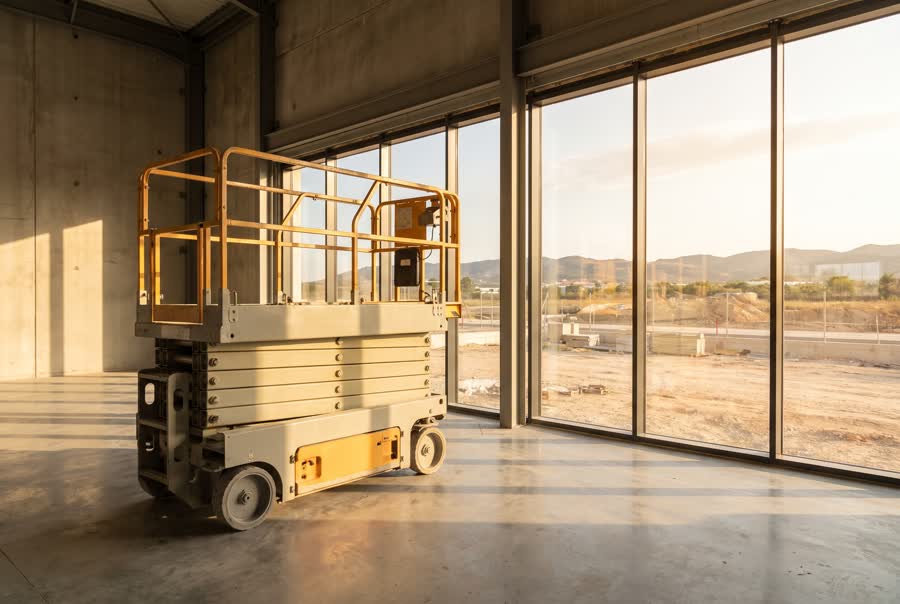
Electric scissor lift 8–10 m
- Working height: 8–10 m
- Basket: 2 people / 230 kg
- Power: Electric, indoor-safe
- Ground: Flat, firm surfaces only
€45/day
Check availability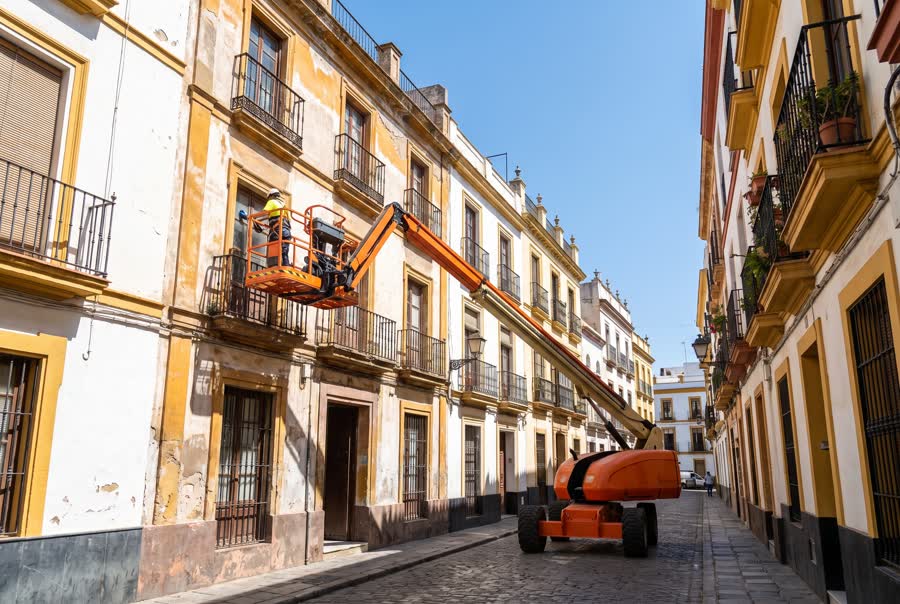
Articulated cherry picker 12–16 m
- Working height: 12–16 m
- Horizontal outreach: 8–9 m
- Basket: 2 people / 230 kg
- Power: Diesel 4×4 or electric
€90/day
Check availabilityTracked spider lift
- Working height: 13–23 m
- Access width: from 0.80 m
- Weight: 1,500–3,000 kg
- Power: Bi-modal diesel + battery
€145/day
Check availabilityPrices 2026
How much does it cost to hire a cherry picker in Spain?
Hiring an access platform in Spain costs from €45 per day excluding VAT for an electric scissor lift of 8–10 m, rising to €320 per day for a 25-metre telescopic boom; delivery is charged separately at €100–250 each way and 21% IVA is added at invoice.
| Type of platform | Day | Week | Month | Deposit |
|---|---|---|---|---|
| Electric scissor lift 8–10 m | €45–90 | €180–350 | €450–900 | €300–800 |
| Diesel scissor lift 12–15 m | €90–160 | €360–620 | €900–1,600 | €500–1,200 |
| Articulated boom 12–16 m | €90–230 | €360–850 | €900–2,100 | €500–1,500 |
| Telescopic boom 20–25 m | €180–320 | €700–1,250 | €1,800–3,000 | €1,000–2,000 |
| Tracked spider lift | €145–260 | €580–1,000 | — | €1,000–2,000 |
Indicative market prices excluding VAT (21% IVA). A week costs roughly four daily rates and a month roughly ten to twelve. Delivery is charged separately at €100–250 per journey depending on distance and machine, and there are two journeys.
Spanish PEMP training rules: what a UK IPAF card does and does not do
This is where hires collapse at the last minute, and it is the single most important thing on this page for anyone arriving from the UK or northern Europe. In Spain an access platform is legally a PEMP — Plataforma Elevadora Móvil de Personal — and not just anyone may operate one. Royal Decree 1215/1997 on work equipment requires an employer to entrust mobile work equipment only to workers who have received specific, documented training for that equipment. That obligation sits with you as the using company, not with the hire firm, and it is the first thing a Spanish health and safety coordinator asks to see if there is an inspection on site.
Your IPAF card is evidence, not an automatic permit
Here is the nuance that catches British contractors out. IPAF is an international scheme and its training is widely respected in Spain; a genuine, in-date PAL card is real, verifiable evidence of competence and many Spanish suppliers will accept it without argument. But it is not a Spanish licence, and there is no rule that obliges anyone to accept it. What the law asks for is training specific to that type of equipment, documented, and appropriate to the work being done — plus, in a Spanish workplace, the risk-assessment paperwork that goes with it. In practice:
- Some hire desks accept an in-date IPAF card for the relevant categories and will release the machine on that basis.
- Some insist on Spanish formación — a certificate issued by a Spanish training provider naming the operator and the platform group.
- On a formal construction site, the safety coordinator sets the bar, and it is usually the stricter of the two. Cards in English alone are frequently queried.
Do not leave this to the delivery driver. Ask at the quote stage whether your documentation will be accepted, and get the answer in writing.
What Spanish PEMP training involves
The course combines theory — machine types, stability, entrapment and overturn risks, harness and anchor points, pre-use checks — with practical work on the machine. You receive a named certificate covering the platform group you were trained on. That is the document attached to the site safety plan alongside the machine's manual and inspection certificate. Courses are widely available, typically run over one or two days, and for companies with employees in Spain they fall within the training credit administered by FUNDAE, which many firms use to cover the cost. Notification deadlines apply, so it cannot be claimed retrospectively.
If there is no time to get trained
Hire the machine with an operator. For a foreign owner running a one-off job on a villa, this is very often the correct answer rather than a fallback: the operator brings their own accreditation and insurance, and you avoid the entire question. No reputable Spanish supplier will hand over a platform on the assumption that untrained people will use it, so decide this before you book, not on the morning of delivery.
Which type of platform each job calls for
Choosing an access platform is about how you reach the work, not only how high it is. Two machines with identical working height behave completely differently once there is a pool, a hedge, a parked car or a projecting balcony in the way. Sort the options by the obstacle in front of you.
Scissor lifts: flat ground and a big platform
A scissor lift goes straight up. It clears no obstacles, but it offers the largest working platform for the money, takes two people with materials, and is the cheapest option per metre of height. Electric models of 8–10 m are the standard machine for warehouse work, installations, suspended ceilings and indoor maintenance: no fumes, they turn on the spot and they pass through normal doorways. Diesel models of 12–15 m with rough-terrain drive are the outdoor version, for firm but uneven ground.
Articulated booms: the cherry picker that goes around things
An articulated boom has one or two knuckles, so it can go up, over an obstacle and back down to the exact point of work. This is the facade machine — the one for buildings with a canopy, a terrace, a swimming pool or mature planting between the base and the wall. At 12 to 16 metres it covers the great majority of residential buildings and mid-sized industrial units, which is why it is the default recommendation for villa and urbanisation work on the coast.
Telescopic booms: maximum height and outreach
A telescopic boom extends a straight arm. It gives up the ability to reach over things in exchange for the greatest horizontal outreach on the market: at 20–25 m of working height you can reach 17–20 m sideways, letting you work over a roof or a fenced area without bringing the base close. This is the choice for large industrial buildings, steelwork and high-level plant maintenance.
Tracked spider lifts: impossible access and delicate surfaces
Spider lifts fold to under a metre wide, pass through a garage door or a garden path, stabilise on four outriggers and reach 13 to 23 metres while weighing about as much as a small car. They run on diesel outside and battery inside. On the Spanish coast they earn their keep constantly: gardens, courtyards, terraces and lawns where a wheeled machine would sink or leave tracks. They cost more — €145–260 per day — but they are frequently the difference between doing the job and not doing it.
What height do you actually need: 10, 12 and 20 metres
The most common and most expensive mistake is ordering the height of the building. Working height already includes the operator's reach, so take the height of the point you need to work at and add roughly two metres — no more. Three brackets cover almost every job.
10 metres
Ten metres of working height is a third floor or the gutter line of a villa. It is the standard electric scissor lift and the small articulated boom. Enough for changing light fittings in a unit, painting a low facade, clearing gutters, fitting signage or pruning trees. An electric scissor at this height is €45–90 per day excluding VAT; an articulated boom reaching the same height starts at €90 per day because of the extra mechanical complexity. A full week on the scissor lift lands at €180–350.
12 metres
Twelve metres is the most requested height in the category, and rightly so: it covers a fourth floor, the ridge of most logistics units and the bulk of residential facades. Two solutions compete. A diesel scissor lift of 12–15 m at €90–160 per day gives you a large basket if the ground allows it. An articulated boom of 12–16 m at €90–230 per day is what you pick when something must be reached over. For facade work on a coastal villa or an urbanisation block, the articulated boom at the lower end of that range is the realistic figure once the hire runs several days.
20 metres
Above twenty metres you are into telescopic territory: tall industrial units, silos, structures, large roof maintenance. Hire starts at €180 per day and reaches €320 per day for 25-metre all-terrain models. At this size transport weighs much more heavily on the invoice, because the machine travels on a low-loader — allow €100–250 per journey and seriously consider a weekly rate, since €700–1,250 for the week dramatically cuts the cost per working day compared with four separate days.
Hiring with an operator: when it is the cheaper answer
Hiring with an operator means the company sends the machine with a professional who drives it. You point at where you need to be and they put you there. It is the standard arrangement for truck-mounted platforms and much spider-lift work, and in Spain it is billed by the hour with a minimum, not by the day.
How it is billed
The market reference for a truck-mounted platform with an operator is €55–90 per hour with a four-hour minimum, so €220–360 for a half day. That rate normally includes travel within the company's usual working area, which is precisely what you pay separately for on a self-drive hire. For work of a day or less, the real gap between the two options is therefore much smaller than the headline rates suggest.
Four cases where it wins
- A two- or three-hour job. Fitting a sign, replacing a light, cutting a branch over a roof — not worth moving a machine for a full day or training anyone.
- Nobody on site holds Spanish-recognised training. The operator brings their own accreditation and insurance, which removes the RD 1215/1997 problem entirely.
- Public road or awkward setting. An experienced operator knows how to stabilise on a pavement, calculate the slew radius and work with the traffic signage.
- Genuinely high, occasional work. Above 25–30 metres you are almost by definition into truck-mounted platforms with an operator.
When it does not win
If the job runs a week or more and you have trained people, self-drive hire is clearly cheaper: €700–1,250 for a telescopic boom for the week against five days of operator time. On long jobs the usual pattern is to hire the machine and train two people so they can relieve each other.
Delivery, deposit, insurance and what the rate excludes
The figure in the table is the machine. Three or four other lines belong in your budget from the beginning, because they are the main source of arguments when the invoice arrives — and the main reason Spanish hire feels more expensive than expected to someone used to UK inclusive pricing.
Delivery
Almost never included. The usual bracket is €100–250 per journey depending on distance and machine size, and there are two journeys: delivery and collection. A spider lift or a large telescopic boom travels on a low-loader and costs more to move. If the property is a long way from the nearest depot, transport can exceed the hire itself on a short job, so always ask for it to be itemised on the quote.
Deposit
The fianza is a deposit returned when the machine comes back in the same condition. It runs from €300–800 on an electric scissor lift to €1,000–2,000 on telescopic booms and spider lifts. It is normally held on a card or paid by transfer, and it is released after the machine has been inspected back at the depot — not at the moment it is collected from you. Photograph the machine on arrival and on collection.
Insurance and liability
The machine travels insured by its owner, but that covers the equipment itself, not damage you cause to third parties and not misuse. Check two things before signing: the excess on the equipment insurance, and whether your own liability policy covers work at height with hired machinery. UK-issued policies do not always extend to work carried out in Spain — worth confirming before, not after.
Fuel, hours and cleaning
Diesel machines are delivered with a full tank and must come back the same or you are billed for refuelling. Many contracts cap daily working hours, typically at eight, and charge for the excess. If the machine returns covered in paint, render or spray foam, expect a cleaning charge.
Where we can deliver an access platform
Spanish hire companies work in a radius from their depot rather than by province, so the final price depends heavily on which yard is nearest you. A property in a coastal town can be cheaper to serve than one in a city centre, where getting a low-loader in is a problem of both logistics and permitted hours.
The coastal belts
On the Costa del Sol, depots around Málaga and the Guadalhorce valley serve Marbella, Estepona, Mijas, Fuengirola and Benalmádena. On the Costa Blanca, yards near Alicante, Elche, Torrevieja, Benidorm and Dénia cover the coastline from Pilar de la Horadada up to Jávea. Both are competitive markets with good availability in scissor lifts and articulated booms up to 16 metres, though the winter renovation season tightens things considerably.
The islands
In Mallorca the calculation changes: fleets are fixed in size, replacements cannot arrive at short notice, and specialist machines such as spider lifts and large telescopic booms book out weeks ahead in season. Rates are comparable to the mainland but timing is not forgiving — allow two to four weeks' notice.
Cities and restricted zones
In Madrid, Barcelona and Valencia there is plenty of supply and real price competition, but access decides everything: low-emission zones, restricted loading hours and parking. In city centres an electric machine is often not a preference but the only option that can legally get in and work. Tell us the postcode and the dates and we will find the depot that can deliver without the transport charge running away with the budget.
FAQ
Access platforms — Common questions
How much does it cost to hire a cherry picker in Spain for one day?
An electric scissor lift of 8–10 m costs €45–90 per day excluding VAT. An articulated boom of 12–16 m runs €90–230 per day and a telescopic boom of 20–25 m €180–320 per day. Add delivery, which is charged separately at €100–250 per journey, and remember 21% IVA goes on top of everything.
Is my UK IPAF card valid in Spain?
It is strong evidence of competence and many Spanish hire companies accept an in-date PAL card, but it is not automatically recognised as a Spanish qualification. RD 1215/1997 requires documented training specific to that equipment, and on formal construction sites the safety coordinator often insists on a Spanish certificate. Ask the supplier at the quote stage whether your card will be accepted and get the answer in writing before you book.
What is a PEMP and why does it matter?
PEMP stands for Plataforma Elevadora Móvil de Personal — mobile elevating work platform. It is the legal category any cherry picker or scissor lift falls into in Spain, and it triggers the training obligation under RD 1215/1997. If you have heard the term on a quote or a delivery note, that is what it means: the machine is a PEMP and whoever operates it must have machine-specific, documented training.
Can I hire a cherry picker with an operator?
Yes, and for short jobs it is often the cheaper and simpler route. It is billed hourly at €55–90 per hour with a four-hour minimum, and that rate usually includes travel within the supplier's normal service area. It is the standard solution when nobody on site holds Spanish-recognised training, because the operator brings their own accreditation and insurance.
What height platform do I need for a three-storey facade?
Three storeys is usually around 9–10 metres to the eaves, so a machine with 12 metres of working height gives you comfortable margin. If there is a canopy, a pool, a garden or parked cars in front, choose an articulated boom rather than a scissor lift — the knuckle lets you set the base to one side and still reach the wall.
Is delivery included in the price?
Other than on operated hires, no. It is invoiced as a separate transport charge of €100–250 per journey depending on distance and machine size, and there are two journeys: delivery and collection. Always ask for it to be itemised, otherwise you cannot compare two quotes meaningfully.
How big a deposit will I be asked for?
It depends on the value of the machine: €300–800 for an electric scissor lift, €500–1,500 for an articulated boom and €1,000–2,000 for telescopic booms and tracked spider lifts. It is released after the machine has been inspected back at the depot, not when it is collected from your site, so allow a few days.
Do the prices include VAT?
No. Every figure on this page is excluding VAT, as is standard for equipment hire in Spain, and 21% IVA is added at invoice. This differs from the inclusive pricing British customers are used to seeing. You receive a full tax invoice, so if you are registered as a business or self-employed in Spain the input VAT is recoverable.
Is there a minimum hire period, and can I hire for a weekend?
The usual minimum is one calendar day; below that the format is operated hire by the hour with a four-hour minimum. Many companies offer a weekend rate, delivering Friday afternoon and collecting Monday morning while charging one or two days. From four days onwards ask directly for the weekly rate, since a week costs roughly four daily rates.
Can I use a diesel platform inside a building?
It is not advisable and is often prohibited by the site safety plan, because exhaust fumes accumulate in enclosed spaces. Indoors you want an electric scissor lift or articulated boom, or a bi-modal tracked platform that runs on battery inside and diesel outside. Say so when requesting a quote and we will only send you offers for suitable machines.
Local coverage
Cherry picker and scissor lift hire in Spain — Other locations
Ready? Request a quote in one minute.
Up to 3 quotes from local suppliers. Free, no obligation.